Tuesday, February 3, 2009

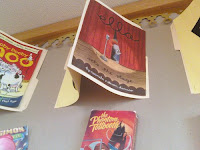
Newbery display.


Wanted to share my Newbery display with you all!


The cards in the top of each book indicate the year it won the Newbery. I'm thinking about pulling them out, though, because people keep asking me if it's okay to check out the books on the display. My Caldecott display is circulating much better (I've replenished it several times a day since I put it up the day the awards were announced) without the year cards. Sometimes fancier isn't better!

Monday, January 12, 2009

Mock Caldecott Program for Class Visits

Has anyone ever done a Mock Caldecott program before? I think it sounds like a lot of fun and something that would be memorable for the kids. I'm thinking of doing the program with first and second graders...kindergarten might be too young.

Here is how my current program outline:
1. Gather about 16-20 books. There are a lot of lists of possible contenders published by other libraries and there is even a spreadsheet created by Jim Averbeck showing which books appear most often on those lists.

2. Print out slips of paper with numbers 1-3. Each number has its own color. For example, 1 is on blue paper, 2 on red, 3 on green, etc.

3. When the class comes, I will explain what the Caldecott award is, show an example, and lead a discussion about the illustrations in picture books.

4. I'll divide the class into 4 or 5 groups and handout the numbered slips to everybody.

5. Each group will examine 4 books at a time.

6. After everyone gets a chance to look at the books, the kids get to vote by raising their slips of paper. Each book will have a number, and one child in each group will be the recorder to record how many votes each book received. (I think I'll create a spreadsheet for the recorder to make it easier.)

7. After everyone votes, I'll rotate the books on to the next group. This will continue until everyone has seen every book or until time runs out.

8. When the class returns, I will read the top 3 books and the kids will vote again to select their Mock Caldecott winner. I'll also announce the national Caldecott winner. This year, the national winner will be announced Monday January 26.

Is this type of a program possible with first and second graders?? Any suggestions?

Result: With a first grade class this was very chaotic. I think for first grade next time I will modify the program--I'll handout the voting slips, read 3 stories, and then have the kids vote and discuss. Perhaps this program is better geared towards grade 3-4. The kids were capable in small groups, but having 5 groups of first graders was just too much.

Friday, January 2, 2009

A Close Friend's Debut Children's Novel


The Truth About Horses, Friends, and My Life as a Coward. Sarah P Gibson. Ill. by Glin Dibley. Marshall Cavendish Children: Tarrytown, NY. 2008. 146 pp.


Mixing the droll, deadpan understatements of the traditional Maine storyteller and the tongue-in-cheek humor of a Sciezska or a Pinkwater, Sarah P. Gibson offers 16 delightful vignettes of native, Maine Islander Sophie Groves’ struggle deciphering what’s easier: living with three crafty, ornery, downright nasty horses or discovering true friendship among her classmates. Her seemingly doomed attempts to win the respect of her family’s three horses, while at the same time navigating the social world of the pre-teen, looking for a friend who is a true friend and not just a (shudder) “horse lover,” provides a unique and funny look at growing up in Maine.


Each chapter is an unexpected and humorous tale of trials and tribulations showing the horses who’s in charge and trying to convince new found friends that horses are not the adorable, noble steeds they are thought to be. Sophie Groves’ understated, dead-on, Laocoön-like predictions of the horses’ behavior along with her friends shocked surprise upon experiencing the true nature of horses, never fails to provoke a laugh. Gibson allows the reader to experience the sweet sensation of knowing better than the characters that enter into Sophie’s life.


Will anyone ever listen to Sophie when it comes to Sweetheart, Fancy Free, and Really? Are sweets the only means of convincing the horses to cooperate? Can she cope with the Carpwells? How easy is it to tell a moose from a horse on Halloween Night? Is there a true friend for Sophie? Find out the truth behind all these questions in Gibson’s The Truth About Horses, Friends, and My Life as a Coward.

Friday, December 26, 2008

Character Counts Booklist

Need to find books that teach specific character traits?

You can find a list at http://charactercounts.org/resources/booklist.php

The booklist includes books ranging from the Grouchy Ladybug to Jacob Have I Loved. It includes author, title, number of pages, type of book, and which trait the book illustrates. Some of the books seem a little outdated, but some books are still in demand and in the FLP system.

The 6 character traits are: trustworthiness, respect, responsibility, fairness, caring, and citizenship.

Monday, December 8, 2008

Signage

It's no secret that I LOVE making signs - the bigger and more elaborate, the better. I typically have 4 or so sign making binges a year. There are just times when I need to make signs!

Here's what I've been up to lately.

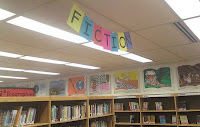
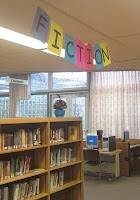
A simple sign made using Comic Sans font, colored paper, and twine. I used MS Publisher and set my paper to landscape format and then made the font as big as I could while still printing two letters a page. I needed the sign to be double-sided since it can be seen from both the book stacks and the circulation desk, but I also needed a sign that didn't require lots of taping, cutting, or lining up. So, I calculated the letters and then laid out each page with two letters like this: F N,I O, C I, T T, I C, O I, N F. After printing out the letters, I folded each sheet in half, used a little bit of tape to hold the fold together, reinforced the top edge of each (now) double-sided letter section using some book tape, punched a couple of holes in the top of each sheet, and then ran some twine through those holes.


I recently made a big shift with my non-fiction, including special collections like Biographies and Holidays. Among those niche collections relocated was my group of atlases. I've wanted to give the atlases a space of their own for while, if only because I had a great idea for a sign in mind. Once I had the books in place, all I needed was a few supplies: bright poster board, thick letters, and some ClipArt make up this sign:
I used Publisher (again) to make an oversized circle (I opted for a custom-sized poster as my layout blank). Then, I looked for the most elementary image of a globe using ClipArt. I wanted something abstract since I wasn't aiming for perfection nor was I intent on cutting out intricate shorelines or islands. Using MS Word, I was able to ungroup the ClipArt image and use just those portions that I wanted. Then, I upsized those little odd looking and non-geographical entities so that they would be semi-proportionate to my blue circle. I printed everything out, cut out the shapes and taped it all together. I think that aspect of sign making really appeals to the puzzle-lover in me - I get to piece it just so. I made the letters using over-sized black font and then cut them out using an Exacto. The whole sign took about an hour to make, start to finish, and it's my current favorite.

My old favorite sign is still going strong at the library:


Eager to assist my patrons, young and old, from the minute they enter the building, I made this sign with them in mind. The letters are angled towards the entrance and on a clear day (that is, a day that isn't 40+ child deep...), the sign is obvious from the circulation desk. I made this sign by blowing up the font to as large as it would go for a single page, taped the lettered sheets to one side of a manilla folder and on the other side, I taped the fronts of recycled book jackets:


Want a closer look at the construction?


I rounded out this display by incorporating old, empty VHS cardboard sleeves. This is definitely a sign that sticks out!


Sorry for the image quality on these - I took the photos using my camera phone!


Friday, December 5, 2008

1,000 Books Before Kindergarten

Earlier this week I came upon this program on some library websites. The goal is to get parents and guardians to read a lot of books to their young children. Some libraries run the program and some schools run the program.

Here are the basics:
  • Kids 0-5 signed up. (In the preschool-kindergarten collaboration kids only participate from sept of last year of preschool to end the kindergarten school year.)

  • Books are bagged in groups of 10.

  • At certain milestones like 100th book, 500th book, etc. the child receives a prize. Prizes can be things like t-shirts, cds of nursery rhymes, etc.

  • At the end of the program, kids get a big prize, certificate, and their picture in a local newspaper.

Example: I contacted the school that does the program. The woman I spoke with said that this is their 3rd year doing the program. They have 240 bags with unique titles (no repeats). This year they have 150 participants. Her school relied on donations for their books.

What I like about the program: It encourages parents to read to their kids and reinforces how important it is. At Oak Lane, I see a lot of elementary age kids, but not many preschoolers or babies.

Questions:

  • How practical do you all think this program is?

  • Would you bag up books? (I'm thinking that to start I'd have 20 bags and then switch them out every 3-4 months)

  • Who would participate? Kids from birth to end of kindergarten? 3-5 year olds?

  • Would you divide the bags into levels? Bag for toddlers, bag for 3-4s, bag for pre-readers and beginning readers? Or mix levels?

Overall, I think the program is worth doing. I will see if my Friends group is willing to collaborate and sponsor prizes. I think it will take me a month or two to get everything set up and organized.

The woman I spoke with is sending me an informational packet. Once I get it, I can I make copies and send it on to any that are interested. Let me know!

Friday, November 14, 2008

Some Old Favorites New

http://www.mothergooserocks.com/

Monday, October 20, 2008

LEAP programming woes.

So, experienced librarians. Let's talk about LEAP programs.

I know we all struggle with this, but I'm about to tear my hair out trying to convince my after-school kids that it's worth their while to participate in planned, structured programs during LEAP hours. We are particularly having issues with those hosted by outside performers. On those days, our regulars mysteriously absent themselves from the building just as the programs are supposed to occur.

My (awesome) new LEAP leader and I have been trying to figure out how to create the expectation that they can and should participate in these programs. So far we have tried snacks and bribery, including offering coupons for 30 extra minutes of computer time if they attend a program from start to finish. Neither has worked. I repeat: not even 30 free minutes of computer time has worked. Everyone disappears from the premises just as the program begins.

I'd shrug my shoulders and simply decide not to book any more programs if not for statistical necessity - we have virtually no school-aged programming otherwise, because kids in this community are so completely overbooked. Plus, isn't part of the point of LEAP to involve kids in an afterschool community? We are working against several years of history where our regulars operate very independently, doing their homework and then playing on the computer until it's time to go home. This is fine to an extent, but I'm not ready to give up yet.

Your suggestions for enticing children to programs - or, better yet, structuring them and creating expectations so that participation is fun and agreeable - are much appreciated! Thanks from the n00b.

Tuesday, September 23, 2008

Scholastic Drops Bratz Books

(from an e-mail sent by Veronica Britto)
This article originally appeared in SLJ's Extra Helping. Sign up now!
By Debra Lau Whelan -- School Library Journal, 9/22/2008 2:00:00 PM

If you haven’t seen any Bratz books or items in your Scholastic catalog it’s because the publisher has dropped the brand from its book clubs and book fairs following complaints that they promote the sexualization of girls.

However, Scholastic says the move was part of a decision to “rotate the books in our book selection,” which happens routinely after consultations with a team of experienced in-house editors who consult with teachers, librarians, and other customers, says company spokeswoman Kyle Good.

The books are a spin-off of the highly popular 10-inch dolls, which have large heads, wide eyes, and full lips—and are often dressed in tight clothing, miniskirts, fishnet stockings, and feather boas.

The American Psychological Association created a "Task Force on the Sexualization of Girls" in February, 2007 and in its report said it was “worrisome when dolls designed specifically for 4- to 8-year-olds are associated with an objectified adult sexuality.”

Additionally, the Campaign for a Commercial-Free Childhood (CCFC), a national coalition that includes health care professionals, educators, advocacy groups, and parents, launched a letter-writing campaign in April 2007 urging Scholastic to stop promoting Bratz items at schools.

“You flooded Scholastic with emails urging them to stop selling books such as Lil' Bratz Dancin Divas, Lil' Bratz Catwalk Cuties, and Lil' Bratz Beauty Sleepover Bash, “said the CCFC. “And in the end, more than 5,000 emails from CCFC members were too much to ignore.”

Good said Scholastic’s decision wasn’t based on those complaints, but that the publisher does listen to what its customers, especially teachers and librarians, have to say. “Our goal has been and continues to be to provide quality, affordable books that meet the wide range of reading levels and interests of today’s students and help every child develop a love of reading,” Scholastic said in a statement.

Good stressed that Scholastic often gets mixed reviews from its customers—even of award-winning authors such as Phillip Pullman—but oftentimes books like the Bratz titles attract reluctant readers.

The last time Bratz books were available in Scholastic book clubs and fairs was last spring, and they are not scheduled for this year, Good says. The books sold very well at clubs during its first year in 2004 and sales have been slipping ever since.

Wednesday, August 27, 2008

These Aren't Your Child's Picture Books Anymore


A middle school teacher wants Leo Lionni books to teach her students how to make inferences. A historical preservationist is reinvigorated by Virginia Lee Burton’s The Little House. Two teenagers flirt and read Wee Little Chick to one another. Picture books are not just for children anymore.

The graphic novel naissance—comics renaissance—has provided entry for a new way of seeing and engaging with picture books. The marriage of picture with text or picture with wordless narrative is no longer just the first step of the serious American reader. Illustrated books with and without words are accepted for all ages, thanks to the successes of the graphic novel. This brings us to the humble picture book and the ways in which graphic novels and picture books have been colliding and expanding and exploding conventions. When American Born Chinese, The Red Book, Zen Shorts, The Invention of Hugo Cabret, and The Wall are award winners, we know there must be a sea-change.

I rediscovered picture books as a children’s librarian—no better way, perhaps. While I loved them as a child, I never thought of them as I traveled the typical reader’s trajectory: reading books for children, books for young adults and books for adults. I love children’s and young adult books because of my work. Most likely I would not have discovered their joys elsewhere. When people think of books—if they think of them at all—they adhere to a linear path linking human development and reading. Surely, reading picture books is regressing! Onward and upward, today Chicka Chicka Boom Boom, tomorrow Moby-Dick.

Like any range of literature, picture books can be gentle or challenging, in the terms of their language, themes, design, and images. Picture books can approach a difficult and complicated subject in a comforting and low-pressure way and they can provoke teen and adult readers to look deeply, intentionally, and closely at content that children might miss.

So what can result from interactions between teens and picture books? Teens can learn about book design in Black and White, The Stinky Cheese Man and Other Fairly Stupid Tales, and The Three Pigs; spirituality in Samsara Dog and The Three Questions; “wolves” in Wolves and The Woolves in the Sitee; animal biology (in rhyme!) in Chickens Aren’t the Only Ones; art elements in Hello, Fruit Face! The Paintings of Giuseppe Arcimboldo, Nina’s Book of Little Things, and Voices in the Park; war and violence in Patrol:An American Soldier in Vietnam, The Letter Home, The Butter Battle Book, and Rose Blanche; and death in Michael Rosen’s Sad Book and To Hell With Dying.

Librarians must educate patrons that the picture book is a format not always prescribed for very young children. This is a challenge when we are constantly asked for the 4-year old, 6-year old, and 12-year old sections and we dutifully point to picture books, easy readers, and chapter books. But we can inform parents and teachers of the myriad ways picture books can be used with teens. Picture books can be microcosmic in the multitudes contained in their brevity. Jon Muth’s books sometimes seem to teach us all we need to know about Buddhism.

Picture books can be used with reluctant readers and visual learners, they can be paired with novels or nonfiction works in history lessons, they can initiate art and design projects, draw on art historical connections and critical thinking strategies, and rekindle the personal experience with literature. As students begin deciphering textual meaning, they can use picture book connections to learn about character development, language, and theme. While we think of storytime as an essentially preschool activity, collaborative out loud engagement with text and image can be pursued with teens.

For the picture book to fulfill its programming potential, it would be ideal to cultivate a young adult collection of picture books. This may be a cataloging or administrative challenge, but as we see graphic novels collected in up to three locations in a building, a home for young adult picture books seems possible. While many children’s picture books can be used successfully with teens, avoiding redundancy is probably desired. There are many picture books that work more deeply and better with teens than with children and would probably get more love in a YA division. Some resources to check out include: http://readwritethink.org, http://vue.org, http://www.picturebookart.org, and http://www.wiredforyouth.com/books/index.cfm?booklist=picture

Titles mentioned
Brannen, Sarah. Uncle Bobby’s Wedding
Browne, Anthony. Voices From the Park
Burton, Virginia Lee. The Little House
Decker, Tim. The Letter Home
Gravett, Emily. Wolves
Haring, Keith. Nina’s Book of Little Things
Heller, Ruth. Chickens Aren’t the Only Ones
Innocenti, Roberto. Rose Blanche
Lionni, Leo.
Lehman, Barbara. The Red Book
Macaulay, David. Black and White
Manos, Helen and Julie Vivas. Samsara Dog
Muth, Jon. The Three Questions
Myers, Walter Dean. Patrol: An American Soldier in Vietnam
Richardson, Justin. And Tango Makes Three
Rosen, Michael. Michael Rosen’s Sad Book
Scieska, Jon and Lane Smith. The Stinky Cheese Man and Other Fairly Stupid Tales.
Selznick, Brian. The Invention of Hugo Cabret
Seuss, Dr. The Butter Battle Book
Sís, Peter. The Wall
Strand, Claudia. Hello, Fruit Face! The Paintings of Giuseppe Arcimboldo
Thompson, Lauren. Wee Little Chick
Walker, Alice. To Hell With Dying
Wiesner, David. Three Little Pigs
Wild, Margaret and Anne Spudvilas. Woolves in the Sitee
Yang, Gene Luen. American Born Chinese