While looking up something at the CIA World Factbook today, I noticed that they have a kids' page. On that kids' page are some neat games, including one in which the player analyzes a photograph to produce useful information.
https://www.cia.gov/kids-page/games/aerial-analysis-challenge/index.html
Once you are done with that, there is the Photo Analysis Challenege, in which you compare the differences between two similar photos of the "same" stretch of a city street.
https://www.cia.gov/kids-page/games/photo-analysis-challenge/index.html
More Games: https://www.cia.gov/kids-page/games/index.html
- Jason Carter
NER
Monday, May 11, 2009

Saturday, May 9, 2009
Real Estate in the library
Hey Northwesters! Many of you know I'm prone to rearranging my collection and it shouldn't surprise you that yet again, I'm feeling the itch to move stuff - basically, as soon as my staff gets used to a current arrangement, I find myself planning a New and Improved arrangement.
One of the things I try to keep in mind when reconfiguring my collection is whether or not the change is truly new and improved. I ask myself if the new location will make sense not just to the staff but to the patrons. Next, I try to validate whether or not I've made the best use of the space available. For instance, for the longest time, I had my DVD/VHS collection situated near the back of the department. It was in plain sight from the door, but one would have to walk the entire length of the department to reach the much-desired collection. This positioning was purely marketing - I placed the collection in the far corner with the expectation that patrons would inevitably pick up other items (books! CDs! anything!). And, for awhile, it did seem as if this tactic was successful. But, in recent months, I noticed that my circulation statistics for this niche of my collection weren't improving despite the popularity of the items. I watched patrons come in to the branch, tractor-beamed to the far corner, blind to all of my other efforts to boost circulation (signs! displays! posters!), and I made the decision to abandon the tried and true supermarket technique (you know, milk in the back corner) because it turns out that this doesn't work as well in my library. So, I moved my DVD collection nearer to the center of everything and so far, so good. I don't have any firm data supporting the move as it's just been a month or so, but I'm pleased with the switch. This new location seems to be more in tune with what my patrons expect. Being able to recognize and act on that is somehow just as important as any other aspect of my job.
When it comes to fitting a collection to a space, there's the most obvious criteria: does that collection physically fit the space? I've had a number of good ideas that were nixed even before being put on paper simply because there would not have been enough room to do what I wanted. Other ideas are nixed because they inherently prevent the potential for collection growth (whether due to a lack of weeding or a surplus in the materials budget...). Nothing says "Don't check these books out!" quite like having to use a crowbar to pry the desired volume off of the shelf.
But there are also some less-obvious criteria for fitting a collection to a space: will it flow from one section to the next? Even if you have the space to put your audiobooks at the end of your reference collection, you shouldn't - there's no flow. Your biographies should go at the end of your reference (or some similar project-based collection, like science fair books). Your audiobooks should be placed as near to your other audio/visual materials as possible - this makes it easier for searching, easier for shelving, and easier for patrons. Is it inviting to the intended patron? I used to shelve my Family Favorites picturebooks (the ones that I found were most-requested: Eric Carle, Dr. Seuss, Curious George, and some others) on top of my picturebooks shelving. Now, the picturebook shelving is low - 3ft tall or so. But, for the intended patron - toddlers and pre-Ks - this was just not the most inviting (or safe, for that matter) arrangement. How could I expect these Family Favorites to circulate if Junior couldn't reach the books or, worse, tried to reach the books by climbing on the shelves (and falling, and getting hurt, and just overall being a no-good, very-bad situation)?
But why am I thinking about rearranging my collection again? I mean, aside from the DVD-shift, did I misunderstand my patrons and their needs? Or have things changed so greatly since the last time I did a major rearrange? Neither of those is the answer - instead, I'm looking at changing the layout of the department for very different reasons than I normally use. One, I'd like to have on-the-floor space for storytimes. With our meeting spaces being more frequently booked, I think it would be nice to be able to invite daycares and preschools to the branch without worrying too terribly much about whether or not the meeting space is available (that's not to say I would just start scheduling things whenever I wanted). The way the department is currently laid out, if I were to do a storytime on the floor (and I've done several), I'd be competing for attention with the front door, the front desk, the computer reservation station, the phone, and patrons and staff moving and milling about. I feel like it would be much better for all involved if I could tuck my picturebooks in the far corner, still within my line of sight but just a bit out of the main lane of library traffic.
The other reason I'd like to make this change is as a response to some behavioral issues among our after school patrons. Try as we might to maintain order, every day we face some level of chaso - whether it's from kids that have been penned up in the classroom all day and are just feeling rammy or it's from the 'tweens and teens who are testing authority, there are days and weeks when the staff goes home exhausted. If changing around my collection helps improve my statistics, I wonder what it would do for behavior issues? Would having the after-school crowd closer to the circulation desk and the guard's station mean a kinder, gentler after-school group? There's only one way to find out, I suppose, so let the to-scale drawings begin!
Question for you all: do you feel that you're making the best use of the space in your library? Do you feel like your collection makes sense or do you look at parts of it and say, "Then there's these books and I don't know what to do with them..."? If you had to brag about one feature of your department, what would it be and why? Any other comments or thoughts about making the most of the real estate in your department?
One of the things I try to keep in mind when reconfiguring my collection is whether or not the change is truly new and improved. I ask myself if the new location will make sense not just to the staff but to the patrons. Next, I try to validate whether or not I've made the best use of the space available. For instance, for the longest time, I had my DVD/VHS collection situated near the back of the department. It was in plain sight from the door, but one would have to walk the entire length of the department to reach the much-desired collection. This positioning was purely marketing - I placed the collection in the far corner with the expectation that patrons would inevitably pick up other items (books! CDs! anything!). And, for awhile, it did seem as if this tactic was successful. But, in recent months, I noticed that my circulation statistics for this niche of my collection weren't improving despite the popularity of the items. I watched patrons come in to the branch, tractor-beamed to the far corner, blind to all of my other efforts to boost circulation (signs! displays! posters!), and I made the decision to abandon the tried and true supermarket technique (you know, milk in the back corner) because it turns out that this doesn't work as well in my library. So, I moved my DVD collection nearer to the center of everything and so far, so good. I don't have any firm data supporting the move as it's just been a month or so, but I'm pleased with the switch. This new location seems to be more in tune with what my patrons expect. Being able to recognize and act on that is somehow just as important as any other aspect of my job.
When it comes to fitting a collection to a space, there's the most obvious criteria: does that collection physically fit the space? I've had a number of good ideas that were nixed even before being put on paper simply because there would not have been enough room to do what I wanted. Other ideas are nixed because they inherently prevent the potential for collection growth (whether due to a lack of weeding or a surplus in the materials budget...). Nothing says "Don't check these books out!" quite like having to use a crowbar to pry the desired volume off of the shelf.
But there are also some less-obvious criteria for fitting a collection to a space: will it flow from one section to the next? Even if you have the space to put your audiobooks at the end of your reference collection, you shouldn't - there's no flow. Your biographies should go at the end of your reference (or some similar project-based collection, like science fair books). Your audiobooks should be placed as near to your other audio/visual materials as possible - this makes it easier for searching, easier for shelving, and easier for patrons. Is it inviting to the intended patron? I used to shelve my Family Favorites picturebooks (the ones that I found were most-requested: Eric Carle, Dr. Seuss, Curious George, and some others) on top of my picturebooks shelving. Now, the picturebook shelving is low - 3ft tall or so. But, for the intended patron - toddlers and pre-Ks - this was just not the most inviting (or safe, for that matter) arrangement. How could I expect these Family Favorites to circulate if Junior couldn't reach the books or, worse, tried to reach the books by climbing on the shelves (and falling, and getting hurt, and just overall being a no-good, very-bad situation)?
But why am I thinking about rearranging my collection again? I mean, aside from the DVD-shift, did I misunderstand my patrons and their needs? Or have things changed so greatly since the last time I did a major rearrange? Neither of those is the answer - instead, I'm looking at changing the layout of the department for very different reasons than I normally use. One, I'd like to have on-the-floor space for storytimes. With our meeting spaces being more frequently booked, I think it would be nice to be able to invite daycares and preschools to the branch without worrying too terribly much about whether or not the meeting space is available (that's not to say I would just start scheduling things whenever I wanted). The way the department is currently laid out, if I were to do a storytime on the floor (and I've done several), I'd be competing for attention with the front door, the front desk, the computer reservation station, the phone, and patrons and staff moving and milling about. I feel like it would be much better for all involved if I could tuck my picturebooks in the far corner, still within my line of sight but just a bit out of the main lane of library traffic.
The other reason I'd like to make this change is as a response to some behavioral issues among our after school patrons. Try as we might to maintain order, every day we face some level of chaso - whether it's from kids that have been penned up in the classroom all day and are just feeling rammy or it's from the 'tweens and teens who are testing authority, there are days and weeks when the staff goes home exhausted. If changing around my collection helps improve my statistics, I wonder what it would do for behavior issues? Would having the after-school crowd closer to the circulation desk and the guard's station mean a kinder, gentler after-school group? There's only one way to find out, I suppose, so let the to-scale drawings begin!
Question for you all: do you feel that you're making the best use of the space in your library? Do you feel like your collection makes sense or do you look at parts of it and say, "Then there's these books and I don't know what to do with them..."? If you had to brag about one feature of your department, what would it be and why? Any other comments or thoughts about making the most of the real estate in your department?
Wednesday, April 22, 2009
Activities for Eric Carle Books
Wandering the web looking for activities parents can share with their kids I came across
http://www.eric-carle.com/catexchange.html
The Caterpillar Exchange is where teachers post ideas based off of Eric Carle's books. Find your favorite Eric Carle title and click on it and then browse the activities. Most of the ideas look simple and fun.
I'm going to try one out the next time I have a kindergarten storytime!
http://www.eric-carle.com/catexchange.html
The Caterpillar Exchange is where teachers post ideas based off of Eric Carle's books. Find your favorite Eric Carle title and click on it and then browse the activities. Most of the ideas look simple and fun.
I'm going to try one out the next time I have a kindergarten storytime!
Saturday, March 7, 2009
The Librarian's Guide to Gaming

An online toolkit for building gaming at your library.
This site was just posted (Mar 2, 2009)by ALA and includes tools and resources, best practices, and even a calendar of conferences and events relating to gaming: traditional, electronic, theory, and education.
And here is a pdf file with a few board games for a wide range of ages, mostly elementary.

Share a Story - Shape a Future - a literacy blog event from ALSC

(To see this article with enabled links got to the ALSC Facebook Page Note.)
During the week of March 9 - 13, please come visit Share a Story - Shape a Future. Each day, a different blog host will feature links to blog posts on a variety of topics having to do with children and literacy. Here is the schedule as of today, but please check the event blog for updated information, as the event is growing by the day.
Day 1 - March 9: Raising Readers
hosted by Terry Doherty at Scrub-a-Dub-Tub, the Reading Tub blog
* Finding Time at Home - Tricia Stohr-Hunt @ The Miss Rumphius Effect
* Making Time in the Classroom - Sarah Mulhern @ The Reading Zone
* Helping a Reader in Need (remedial readers) - Sandra Stiles guest post on Scrub-a-Dub-Tub
* It’s Bigger than the Book: Building Strong Readers at any Age with a Daily Dose of Read Aloud - Cathy Miller interview on the Share a Story - Shape a Future blog
* Keeping Gifted Readers Engaged - Donalyn Miller @ The Book Whisperer
Day 2 - March 10: Selecting Reading Material
hosted by Sarah Mulhern at The Reading Zone
* The ABCs of Reading: Infants, Toddlers & Preschoolers - Valerie Baartz on The Almost Librarian
* How to Help Emerging Readers - Anastasia Suen @5 Great Books NEW LOCATION!
* Helping Middle Grade Readers - Sarah Mulhern @ The Reading Zone
* Booklists and Read Alikes - Sarah Mulhern @ The Reading Zone
* Using Non-fiction - Mary Lee Hahn of A Year of Reading, hosted by the Stenhouse blog
Day 3 - March 11: Reading Aloud - It’s Fun, It’s Easy
hosted by Susan Stephenson at the Book Chook blog
* Ten Terrific Tips from Read-aloud Queen, Mem Fox - on the Book Chook blog
* Conquering Stage Fright - Interview with Sarah Mulhern/The Reading Zone @ the Book Chook
* Reading Aloud With Kids: A Dad’s Perspective - hosted by Steven and Brian at Book Dads: Fathers that Read
* Using Technology for Read Alouds - Sarah Mulhern @ The Reading Zone
* What to Do When the Reading is Done - Aimee Buckner, hosted by the Stenhouse blog
* Reading Aloud with Independent Readers - Donalyn Miller @ The Book Whisperer
Day 4 - March 12: A Visit to the Library
hosted by Eva Mitnick at Eva’s Book Addiction blog
* From Cozy to Cool - Library Spaces for Everyone - Eva @ Eva’s Book Addiction
* Lions and Marble and Books, Oh My - Betsy Bird at A Fuse #8 Production
* How to Make the Library Work for YOU - an interview with Adrienne of What Adrienne Thinks About That conducted by Jules at Seven Impossible Things Before Breakfast
* The World Beyond the Library’s Walls - Melissa @ Librarian by Day
Day 5 - March 13: Technology and Reading - What the Future Holds
is hosted by Elizabeth O. Dulemba at Dulemba.com
* Audiobooks with Bruce Coville of Full Cast Audio and Mary Burkey of Audiobooker
* E-books with Harold Underdown of The Purple Crayon and Sheila Ruth of Wands and Worlds
* Podcasts with Andrea Ross of Just One More Book! and Cheryl Rainfield of cherylrainfield.com
* A resource of links to audiobooks, e-books, podcasts and webcasts @ Dulemba.com.
There will be plenty of giveaways, contests, and links to cool stuff, and most of all - inspiring and insightful posts by children’s literature bloggers. Guests will be invited to share their own knowledge and love of reading as well. Please tell parents and teachers and fellow children’s librarians about this blog event. See you then!
Tuesday, February 3, 2009
Newbery display.


Wanted to share my Newbery display with you all!
The cards in the top of each book indicate the year it won the Newbery. I'm thinking about pulling them out, though, because people keep asking me if it's okay to check out the books on the display. My Caldecott display is circulating much better (I've replenished it several times a day since I put it up the day the awards were announced) without the year cards. Sometimes fancier isn't better!
Monday, January 12, 2009
Mock Caldecott Program for Class Visits
Has anyone ever done a Mock Caldecott program before? I think it sounds like a lot of fun and something that would be memorable for the kids. I'm thinking of doing the program with first and second graders...kindergarten might be too young.
Here is how my current program outline:
1. Gather about 16-20 books. There are a lot of lists of possible contenders published by other libraries and there is even a spreadsheet created by Jim Averbeck showing which books appear most often on those lists.
2. Print out slips of paper with numbers 1-3. Each number has its own color. For example, 1 is on blue paper, 2 on red, 3 on green, etc.
3. When the class comes, I will explain what the Caldecott award is, show an example, and lead a discussion about the illustrations in picture books.
4. I'll divide the class into 4 or 5 groups and handout the numbered slips to everybody.
5. Each group will examine 4 books at a time.
6. After everyone gets a chance to look at the books, the kids get to vote by raising their slips of paper. Each book will have a number, and one child in each group will be the recorder to record how many votes each book received. (I think I'll create a spreadsheet for the recorder to make it easier.)
7. After everyone votes, I'll rotate the books on to the next group. This will continue until everyone has seen every book or until time runs out.
8. When the class returns, I will read the top 3 books and the kids will vote again to select their Mock Caldecott winner. I'll also announce the national Caldecott winner. This year, the national winner will be announced Monday January 26.
Is this type of a program possible with first and second graders?? Any suggestions?
Result: With a first grade class this was very chaotic. I think for first grade next time I will modify the program--I'll handout the voting slips, read 3 stories, and then have the kids vote and discuss. Perhaps this program is better geared towards grade 3-4. The kids were capable in small groups, but having 5 groups of first graders was just too much.
Here is how my current program outline:
1. Gather about 16-20 books. There are a lot of lists of possible contenders published by other libraries and there is even a spreadsheet created by Jim Averbeck showing which books appear most often on those lists.
2. Print out slips of paper with numbers 1-3. Each number has its own color. For example, 1 is on blue paper, 2 on red, 3 on green, etc.
3. When the class comes, I will explain what the Caldecott award is, show an example, and lead a discussion about the illustrations in picture books.
4. I'll divide the class into 4 or 5 groups and handout the numbered slips to everybody.
5. Each group will examine 4 books at a time.
6. After everyone gets a chance to look at the books, the kids get to vote by raising their slips of paper. Each book will have a number, and one child in each group will be the recorder to record how many votes each book received. (I think I'll create a spreadsheet for the recorder to make it easier.)
7. After everyone votes, I'll rotate the books on to the next group. This will continue until everyone has seen every book or until time runs out.
8. When the class returns, I will read the top 3 books and the kids will vote again to select their Mock Caldecott winner. I'll also announce the national Caldecott winner. This year, the national winner will be announced Monday January 26.
Is this type of a program possible with first and second graders?? Any suggestions?
Result: With a first grade class this was very chaotic. I think for first grade next time I will modify the program--I'll handout the voting slips, read 3 stories, and then have the kids vote and discuss. Perhaps this program is better geared towards grade 3-4. The kids were capable in small groups, but having 5 groups of first graders was just too much.
Friday, January 2, 2009
A Close Friend's Debut Children's Novel

The Truth About Horses, Friends, and My Life as a Coward. Sarah P Gibson. Ill. by Glin Dibley. Marshall Cavendish Children: Tarrytown, NY. 2008. 146 pp.
Mixing the droll, deadpan understatements of the traditional Maine storyteller and the tongue-in-cheek humor of a Sciezska or a Pinkwater, Sarah P. Gibson offers 16 delightful vignettes of native, Maine Islander Sophie Groves’ struggle deciphering what’s easier: living with three crafty, ornery, downright nasty horses or discovering true friendship among her classmates. Her seemingly doomed attempts to win the respect of her family’s three horses, while at the same time navigating the social world of the pre-teen, looking for a friend who is a true friend and not just a (shudder) “horse lover,” provides a unique and funny look at growing up in Maine.
Each chapter is an unexpected and humorous tale of trials and tribulations showing the horses who’s in charge and trying to convince new found friends that horses are not the adorable, noble steeds they are thought to be. Sophie Groves’ understated, dead-on, Laocoön-like predictions of the horses’ behavior along with her friends shocked surprise upon experiencing the true nature of horses, never fails to provoke a laugh. Gibson allows the reader to experience the sweet sensation of knowing better than the characters that enter into Sophie’s life.
Will anyone ever listen to Sophie when it comes to Sweetheart, Fancy Free, and Really? Are sweets the only means of convincing the horses to cooperate? Can she cope with the Carpwells? How easy is it to tell a moose from a horse on Halloween Night? Is there a true friend for Sophie? Find out the truth behind all these questions in Gibson’s The Truth About Horses, Friends, and My Life as a Coward.
Friday, December 26, 2008
Character Counts Booklist
Need to find books that teach specific character traits?
You can find a list at http://charactercounts.org/resources/booklist.php
The booklist includes books ranging from the Grouchy Ladybug to Jacob Have I Loved. It includes author, title, number of pages, type of book, and which trait the book illustrates. Some of the books seem a little outdated, but some books are still in demand and in the FLP system.
The 6 character traits are: trustworthiness, respect, responsibility, fairness, caring, and citizenship.
You can find a list at http://charactercounts.org/resources/booklist.php
The booklist includes books ranging from the Grouchy Ladybug to Jacob Have I Loved. It includes author, title, number of pages, type of book, and which trait the book illustrates. Some of the books seem a little outdated, but some books are still in demand and in the FLP system.
The 6 character traits are: trustworthiness, respect, responsibility, fairness, caring, and citizenship.
Monday, December 8, 2008
Signage
It's no secret that I LOVE making signs - the bigger and more elaborate, the better. I typically have 4 or so sign making binges a year. There are just times when I need to make signs!
Here's what I've been up to lately.
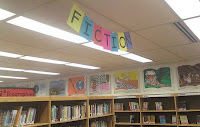
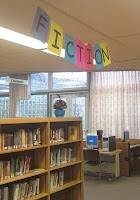
A simple sign made using Comic Sans font, colored paper, and twine. I used MS Publisher and set my paper to landscape format and then made the font as big as I could while still printing two letters a page. I needed the sign to be double-sided since it can be seen from both the book stacks and the circulation desk, but I also needed a sign that didn't require lots of taping, cutting, or lining up. So, I calculated the letters and then laid out each page with two letters like this: F N,I O, C I, T T, I C, O I, N F. After printing out the letters, I folded each sheet in half, used a little bit of tape to hold the fold together, reinforced the top edge of each (now) double-sided letter section using some book tape, punched a couple of holes in the top of each sheet, and then ran some twine through those holes.

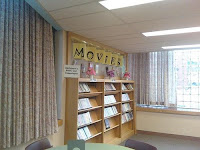
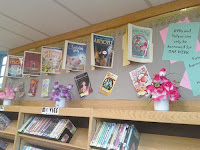
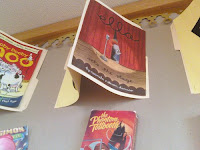
Sorry for the image quality on these - I took the photos using my camera phone!
Here's what I've been up to lately.
A simple sign made using Comic Sans font, colored paper, and twine. I used MS Publisher and set my paper to landscape format and then made the font as big as I could while still printing two letters a page. I needed the sign to be double-sided since it can be seen from both the book stacks and the circulation desk, but I also needed a sign that didn't require lots of taping, cutting, or lining up. So, I calculated the letters and then laid out each page with two letters like this: F N,I O, C I, T T, I C, O I, N F. After printing out the letters, I folded each sheet in half, used a little bit of tape to hold the fold together, reinforced the top edge of each (now) double-sided letter section using some book tape, punched a couple of holes in the top of each sheet, and then ran some twine through those holes.
I recently made a big shift with my non-fiction, including special collections like Biographies and Holidays. Among those niche collections relocated was my group of atlases. I've wanted to give the atlases a space of their own for while, if only because I had a great idea for a sign in mind. Once I had the books in place, all I needed was a few supplies: bright poster board, thick letters, and some ClipArt make up this sign:
I used Publisher (again) to make an oversized circle (I opted for a custom-sized poster as my layout blank). Then, I looked for the most elementary image of a globe using ClipArt. I wanted something abstract since I wasn't aiming for perfection nor was I intent on cutting out intricate shorelines or islands. Using MS Word, I was able to ungroup the ClipArt image and use just those portions that I wanted. Then, I upsized those little odd looking and non-geographical entities so that they would be semi-proportionate to my blue circle. I printed everything out, cut out the shapes and taped it all together. I think that aspect of sign making really appeals to the puzzle-lover in me - I get to piece it just so. I made the letters using over-sized black font and then cut them out using an Exacto. The whole sign took about an hour to make, start to finish, and it's my current favorite.
My old favorite sign is still going strong at the library:
Eager to assist my patrons, young and old, from the minute they enter the building, I made this sign with them in mind. The letters are angled towards the entrance and on a clear day (that is, a day that isn't 40+ child deep...), the sign is obvious from the circulation desk. I made this sign by blowing up the font to as large as it would go for a single page, taped the lettered sheets to one side of a manilla folder and on the other side, I taped the fronts of recycled book jackets:
Want a closer look at the construction?
I rounded out this display by incorporating old, empty VHS cardboard sleeves. This is definitely a sign that sticks out!
Sorry for the image quality on these - I took the photos using my camera phone!
Friday, December 5, 2008
1,000 Books Before Kindergarten
Earlier this week I came upon this program on some library websites. The goal is to get parents and guardians to read a lot of books to their young children. Some libraries run the program and some schools run the program.
Here are the basics:
Here are the basics:
- Kids 0-5 signed up. (In the preschool-kindergarten collaboration kids only participate from sept of last year of preschool to end the kindergarten school year.)
- Books are bagged in groups of 10.
- At certain milestones like 100th book, 500th book, etc. the child receives a prize. Prizes can be things like t-shirts, cds of nursery rhymes, etc.
- At the end of the program, kids get a big prize, certificate, and their picture in a local newspaper.
Example: I contacted the school that does the program. The woman I spoke with said that this is their 3rd year doing the program. They have 240 bags with unique titles (no repeats). This year they have 150 participants. Her school relied on donations for their books.
What I like about the program: It encourages parents to read to their kids and reinforces how important it is. At Oak Lane, I see a lot of elementary age kids, but not many preschoolers or babies.
Questions:
- How practical do you all think this program is?
- Would you bag up books? (I'm thinking that to start I'd have 20 bags and then switch them out every 3-4 months)
- Who would participate? Kids from birth to end of kindergarten? 3-5 year olds?
- Would you divide the bags into levels? Bag for toddlers, bag for 3-4s, bag for pre-readers and beginning readers? Or mix levels?
Overall, I think the program is worth doing. I will see if my Friends group is willing to collaborate and sponsor prizes. I think it will take me a month or two to get everything set up and organized.
The woman I spoke with is sending me an informational packet. Once I get it, I can I make copies and send it on to any that are interested. Let me know!
Friday, November 14, 2008
Monday, October 20, 2008
LEAP programming woes.
So, experienced librarians. Let's talk about LEAP programs.
I know we all struggle with this, but I'm about to tear my hair out trying to convince my after-school kids that it's worth their while to participate in planned, structured programs during LEAP hours. We are particularly having issues with those hosted by outside performers. On those days, our regulars mysteriously absent themselves from the building just as the programs are supposed to occur.
My (awesome) new LEAP leader and I have been trying to figure out how to create the expectation that they can and should participate in these programs. So far we have tried snacks and bribery, including offering coupons for 30 extra minutes of computer time if they attend a program from start to finish. Neither has worked. I repeat: not even 30 free minutes of computer time has worked. Everyone disappears from the premises just as the program begins.
I'd shrug my shoulders and simply decide not to book any more programs if not for statistical necessity - we have virtually no school-aged programming otherwise, because kids in this community are so completely overbooked. Plus, isn't part of the point of LEAP to involve kids in an afterschool community? We are working against several years of history where our regulars operate very independently, doing their homework and then playing on the computer until it's time to go home. This is fine to an extent, but I'm not ready to give up yet.
Your suggestions for enticing children to programs - or, better yet, structuring them and creating expectations so that participation is fun and agreeable - are much appreciated! Thanks from the n00b.
I know we all struggle with this, but I'm about to tear my hair out trying to convince my after-school kids that it's worth their while to participate in planned, structured programs during LEAP hours. We are particularly having issues with those hosted by outside performers. On those days, our regulars mysteriously absent themselves from the building just as the programs are supposed to occur.
My (awesome) new LEAP leader and I have been trying to figure out how to create the expectation that they can and should participate in these programs. So far we have tried snacks and bribery, including offering coupons for 30 extra minutes of computer time if they attend a program from start to finish. Neither has worked. I repeat: not even 30 free minutes of computer time has worked. Everyone disappears from the premises just as the program begins.
I'd shrug my shoulders and simply decide not to book any more programs if not for statistical necessity - we have virtually no school-aged programming otherwise, because kids in this community are so completely overbooked. Plus, isn't part of the point of LEAP to involve kids in an afterschool community? We are working against several years of history where our regulars operate very independently, doing their homework and then playing on the computer until it's time to go home. This is fine to an extent, but I'm not ready to give up yet.
Your suggestions for enticing children to programs - or, better yet, structuring them and creating expectations so that participation is fun and agreeable - are much appreciated! Thanks from the n00b.
Tuesday, September 23, 2008
Scholastic Drops Bratz Books
(from an e-mail sent by Veronica Britto)
This article originally appeared in SLJ's Extra Helping. Sign up now!
By Debra Lau Whelan -- School Library Journal, 9/22/2008 2:00:00 PM
If you haven’t seen any Bratz books or items in your Scholastic catalog it’s because the publisher has dropped the brand from its book clubs and book fairs following complaints that they promote the sexualization of girls.
However, Scholastic says the move was part of a decision to “rotate the books in our book selection,” which happens routinely after consultations with a team of experienced in-house editors who consult with teachers, librarians, and other customers, says company spokeswoman Kyle Good.
The books are a spin-off of the highly popular 10-inch dolls, which have large heads, wide eyes, and full lips—and are often dressed in tight clothing, miniskirts, fishnet stockings, and feather boas.
The American Psychological Association created a "Task Force on the Sexualization of Girls" in February, 2007 and in its report said it was “worrisome when dolls designed specifically for 4- to 8-year-olds are associated with an objectified adult sexuality.”
Additionally, the Campaign for a Commercial-Free Childhood (CCFC), a national coalition that includes health care professionals, educators, advocacy groups, and parents, launched a letter-writing campaign in April 2007 urging Scholastic to stop promoting Bratz items at schools.
“You flooded Scholastic with emails urging them to stop selling books such as Lil' Bratz Dancin Divas, Lil' Bratz Catwalk Cuties, and Lil' Bratz Beauty Sleepover Bash, “said the CCFC. “And in the end, more than 5,000 emails from CCFC members were too much to ignore.”
Good said Scholastic’s decision wasn’t based on those complaints, but that the publisher does listen to what its customers, especially teachers and librarians, have to say. “Our goal has been and continues to be to provide quality, affordable books that meet the wide range of reading levels and interests of today’s students and help every child develop a love of reading,” Scholastic said in a statement.
Good stressed that Scholastic often gets mixed reviews from its customers—even of award-winning authors such as Phillip Pullman—but oftentimes books like the Bratz titles attract reluctant readers.
The last time Bratz books were available in Scholastic book clubs and fairs was last spring, and they are not scheduled for this year, Good says. The books sold very well at clubs during its first year in 2004 and sales have been slipping ever since.
This article originally appeared in SLJ's Extra Helping. Sign up now!
By Debra Lau Whelan -- School Library Journal, 9/22/2008 2:00:00 PM
If you haven’t seen any Bratz books or items in your Scholastic catalog it’s because the publisher has dropped the brand from its book clubs and book fairs following complaints that they promote the sexualization of girls.
However, Scholastic says the move was part of a decision to “rotate the books in our book selection,” which happens routinely after consultations with a team of experienced in-house editors who consult with teachers, librarians, and other customers, says company spokeswoman Kyle Good.
The books are a spin-off of the highly popular 10-inch dolls, which have large heads, wide eyes, and full lips—and are often dressed in tight clothing, miniskirts, fishnet stockings, and feather boas.
The American Psychological Association created a "Task Force on the Sexualization of Girls" in February, 2007 and in its report said it was “worrisome when dolls designed specifically for 4- to 8-year-olds are associated with an objectified adult sexuality.”
Additionally, the Campaign for a Commercial-Free Childhood (CCFC), a national coalition that includes health care professionals, educators, advocacy groups, and parents, launched a letter-writing campaign in April 2007 urging Scholastic to stop promoting Bratz items at schools.
“You flooded Scholastic with emails urging them to stop selling books such as Lil' Bratz Dancin Divas, Lil' Bratz Catwalk Cuties, and Lil' Bratz Beauty Sleepover Bash, “said the CCFC. “And in the end, more than 5,000 emails from CCFC members were too much to ignore.”
Good said Scholastic’s decision wasn’t based on those complaints, but that the publisher does listen to what its customers, especially teachers and librarians, have to say. “Our goal has been and continues to be to provide quality, affordable books that meet the wide range of reading levels and interests of today’s students and help every child develop a love of reading,” Scholastic said in a statement.
Good stressed that Scholastic often gets mixed reviews from its customers—even of award-winning authors such as Phillip Pullman—but oftentimes books like the Bratz titles attract reluctant readers.
The last time Bratz books were available in Scholastic book clubs and fairs was last spring, and they are not scheduled for this year, Good says. The books sold very well at clubs during its first year in 2004 and sales have been slipping ever since.
Wednesday, August 27, 2008
These Aren't Your Child's Picture Books Anymore

A middle school teacher wants Leo Lionni books to teach her students how to make inferences. A historical preservationist is reinvigorated by Virginia Lee Burton’s The Little House. Two teenagers flirt and read Wee Little Chick to one another. Picture books are not just for children anymore.
The graphic novel naissance—comics renaissance—has provided entry for a new way of seeing and engaging with picture books. The marriage of picture with text or picture with wordless narrative is no longer just the first step of the serious American reader. Illustrated books with and without words are accepted for all ages, thanks to the successes of the graphic novel. This brings us to the humble picture book and the ways in which graphic novels and picture books have been colliding and expanding and exploding conventions. When American Born Chinese, The Red Book, Zen Shorts, The Invention of Hugo Cabret, and The Wall are award winners, we know there must be a sea-change.
I rediscovered picture books as a children’s librarian—no better way, perhaps. While I loved them as a child, I never thought of them as I traveled the typical reader’s trajectory: reading books for children, books for young adults and books for adults. I love children’s and young adult books because of my work. Most likely I would not have discovered their joys elsewhere. When people think of books—if they think of them at all—they adhere to a linear path linking human development and reading. Surely, reading picture books is regressing! Onward and upward, today Chicka Chicka Boom Boom, tomorrow Moby-Dick.
Like any range of literature, picture books can be gentle or challenging, in the terms of their language, themes, design, and images. Picture books can approach a difficult and complicated subject in a comforting and low-pressure way and they can provoke teen and adult readers to look deeply, intentionally, and closely at content that children might miss.
So what can result from interactions between teens and picture books? Teens can learn about book design in Black and White, The Stinky Cheese Man and Other Fairly Stupid Tales, and The Three Pigs; spirituality in Samsara Dog and The Three Questions; “wolves” in Wolves and The Woolves in the Sitee; animal biology (in rhyme!) in Chickens Aren’t the Only Ones; art elements in Hello, Fruit Face! The Paintings of Giuseppe Arcimboldo, Nina’s Book of Little Things, and Voices in the Park; war and violence in Patrol:An American Soldier in Vietnam, The Letter Home, The Butter Battle Book, and Rose Blanche; and death in Michael Rosen’s Sad Book and To Hell With Dying.
Librarians must educate patrons that the picture book is a format not always prescribed for very young children. This is a challenge when we are constantly asked for the 4-year old, 6-year old, and 12-year old sections and we dutifully point to picture books, easy readers, and chapter books. But we can inform parents and teachers of the myriad ways picture books can be used with teens. Picture books can be microcosmic in the multitudes contained in their brevity. Jon Muth’s books sometimes seem to teach us all we need to know about Buddhism.
Picture books can be used with reluctant readers and visual learners, they can be paired with novels or nonfiction works in history lessons, they can initiate art and design projects, draw on art historical connections and critical thinking strategies, and rekindle the personal experience with literature. As students begin deciphering textual meaning, they can use picture book connections to learn about character development, language, and theme. While we think of storytime as an essentially preschool activity, collaborative out loud engagement with text and image can be pursued with teens.
For the picture book to fulfill its programming potential, it would be ideal to cultivate a young adult collection of picture books. This may be a cataloging or administrative challenge, but as we see graphic novels collected in up to three locations in a building, a home for young adult picture books seems possible. While many children’s picture books can be used successfully with teens, avoiding redundancy is probably desired. There are many picture books that work more deeply and better with teens than with children and would probably get more love in a YA division. Some resources to check out include: http://readwritethink.org, http://vue.org, http://www.picturebookart.org, and http://www.wiredforyouth.com/books/index.cfm?booklist=picture
Titles mentioned
Brannen, Sarah. Uncle Bobby’s Wedding
Browne, Anthony. Voices From the Park
Burton, Virginia Lee. The Little House
Decker, Tim. The Letter Home
Gravett, Emily. Wolves
Haring, Keith. Nina’s Book of Little Things
Heller, Ruth. Chickens Aren’t the Only Ones
Innocenti, Roberto. Rose Blanche
Lionni, Leo.
Lehman, Barbara. The Red Book
Macaulay, David. Black and White
Manos, Helen and Julie Vivas. Samsara Dog
Muth, Jon. The Three Questions
Myers, Walter Dean. Patrol: An American Soldier in Vietnam
Richardson, Justin. And Tango Makes Three
Rosen, Michael. Michael Rosen’s Sad Book
Scieska, Jon and Lane Smith. The Stinky Cheese Man and Other Fairly Stupid Tales.
Selznick, Brian. The Invention of Hugo Cabret
Seuss, Dr. The Butter Battle Book
Sís, Peter. The Wall
Strand, Claudia. Hello, Fruit Face! The Paintings of Giuseppe Arcimboldo
Thompson, Lauren. Wee Little Chick
Walker, Alice. To Hell With Dying
Wiesner, David. Three Little Pigs
Wild, Margaret and Anne Spudvilas. Woolves in the Sitee
Yang, Gene Luen. American Born Chinese
Friday, August 22, 2008
A Moment off Topic, Please
Developer of Irish capital's public library service
Sat, Aug 16, 2008
MÁIRÍN O'BYRNE, who has died aged 88, was a former Dublin city and county librarian, and did much to develop the public library service throughout the city and suburbs.
Deeply committed to public service, she passionately believed that libraries could make a difference to the lives of those who did not have formal education and was a great believer in life-long education.
Máirín O'Byrne began her career in Dún Laoghaire public library in 1937 and secured a diploma in library training at University College Dublin in 1943. For 15 years from 1946, she was librarian in Bray public library, which was then independent of Wicklow county library.
It was in a poor state when she took over and she made massive strides in bringing the facilities up to date.
She took up the position of Dublin city librarian in 1961 and was appointed Dublin city and county librarian in 1967, which she held until her retirement in 1984.
She sought to enhance the physical environment of libraries and persuaded the Arts Council to fund a mural by Eithne Jordan for Swords library, while convincing a local councillor and publican to fund a piece of sculpture by Conor Fallon.
She was held in high regard among her peers, being elected as president of the Library Association (1966-1967). She certainly made a difference, taking a particular interest in the development of professional qualifications for library staff.
The holder of an honorary fellowship of the Library Association of Ireland, she also was honorary (life) vice president of the Library Association (UK), chairwoman of the Public Library Review Group (1985) and visiting lecturer at the Department of library studies at UCD.
She was a member of An Chomhairle Leabharlanna/the Library Council (1958-1982), the RTÉ Authority, the Public Service Advisory Council and was a trustee of the National Library. A regular contributor to An Leabharlann, she also was co-author of the Public Library Review Report(1987).
Born in 1919, she was the eldest of the four children and only daughter of William and Mary O'Byrne.
Both her parents were school teachers. Her father was from Paulstown, Co Kilkenny, and her mother was from Clandouglas, Lixnaw, Co Kerry.
The family grew up in Kildangan, Co Kildare, where her father was principal of the local national school for more than 30 years.
She attended secondary school at the Mercy Sisters convent in Monasterevin. Most summers were spent in Ballybunion and her Irish was perfected in the Kerry Gaeltacht of Ballyferriter and Waterford Gaeltacht of Ring.
She settled in Albert Road, Glenageary, Co Dublin, in the early 1950, and was joined there by her parents after her father's retirement. He suffered from muscular dystrophy in his final years and was nursed by Máirín and her mother. He died in 1955.
Máirín's mother lived with her until her death in 1970. Two years later Máirín moved to another house on the same road, which became her home for the next 36 years.
She provided a home from home for her brothers Kieran and Brendan, who were priests in the diocese of Kildare and Leighlin. They did not enjoy perfect health and both were nursed from time to time by Máirín, allowing them to continue their priestly duties until their deaths in 1995 and 2002.
Her eldest brother Séamus practised as a pharmacist in Sutton for 35 years. Married to Pearl, they had six children, Máirín's only nieces and nephews. She cared for Pearl after Séamus's death in 2003.
She never married but was a great family person.
Former colleagues admired her sharp intellect, wit, sense of fun, generosity of spirit and admired her courage in the face of a slowly advancing illness.
A dynamic person, she was very involved the life of Dublin city. She had a great personal interest in art, and she loved her garden and her dogs.
Máirín O'Byrne: born December 5th, 1919; died August 1st, 2008
© 2008 The Irish Times
Sat, Aug 16, 2008
MÁIRÍN O'BYRNE, who has died aged 88, was a former Dublin city and county librarian, and did much to develop the public library service throughout the city and suburbs.
Deeply committed to public service, she passionately believed that libraries could make a difference to the lives of those who did not have formal education and was a great believer in life-long education.
Máirín O'Byrne began her career in Dún Laoghaire public library in 1937 and secured a diploma in library training at University College Dublin in 1943. For 15 years from 1946, she was librarian in Bray public library, which was then independent of Wicklow county library.
It was in a poor state when she took over and she made massive strides in bringing the facilities up to date.
She took up the position of Dublin city librarian in 1961 and was appointed Dublin city and county librarian in 1967, which she held until her retirement in 1984.
She sought to enhance the physical environment of libraries and persuaded the Arts Council to fund a mural by Eithne Jordan for Swords library, while convincing a local councillor and publican to fund a piece of sculpture by Conor Fallon.
She was held in high regard among her peers, being elected as president of the Library Association (1966-1967). She certainly made a difference, taking a particular interest in the development of professional qualifications for library staff.
The holder of an honorary fellowship of the Library Association of Ireland, she also was honorary (life) vice president of the Library Association (UK), chairwoman of the Public Library Review Group (1985) and visiting lecturer at the Department of library studies at UCD.
She was a member of An Chomhairle Leabharlanna/the Library Council (1958-1982), the RTÉ Authority, the Public Service Advisory Council and was a trustee of the National Library. A regular contributor to An Leabharlann, she also was co-author of the Public Library Review Report(1987).
Born in 1919, she was the eldest of the four children and only daughter of William and Mary O'Byrne.
Both her parents were school teachers. Her father was from Paulstown, Co Kilkenny, and her mother was from Clandouglas, Lixnaw, Co Kerry.
The family grew up in Kildangan, Co Kildare, where her father was principal of the local national school for more than 30 years.
She attended secondary school at the Mercy Sisters convent in Monasterevin. Most summers were spent in Ballybunion and her Irish was perfected in the Kerry Gaeltacht of Ballyferriter and Waterford Gaeltacht of Ring.
She settled in Albert Road, Glenageary, Co Dublin, in the early 1950, and was joined there by her parents after her father's retirement. He suffered from muscular dystrophy in his final years and was nursed by Máirín and her mother. He died in 1955.
Máirín's mother lived with her until her death in 1970. Two years later Máirín moved to another house on the same road, which became her home for the next 36 years.
She provided a home from home for her brothers Kieran and Brendan, who were priests in the diocese of Kildare and Leighlin. They did not enjoy perfect health and both were nursed from time to time by Máirín, allowing them to continue their priestly duties until their deaths in 1995 and 2002.
Her eldest brother Séamus practised as a pharmacist in Sutton for 35 years. Married to Pearl, they had six children, Máirín's only nieces and nephews. She cared for Pearl after Séamus's death in 2003.
She never married but was a great family person.
Former colleagues admired her sharp intellect, wit, sense of fun, generosity of spirit and admired her courage in the face of a slowly advancing illness.
A dynamic person, she was very involved the life of Dublin city. She had a great personal interest in art, and she loved her garden and her dogs.
Máirín O'Byrne: born December 5th, 1919; died August 1st, 2008
© 2008 The Irish Times
Tuesday, August 12, 2008
Let's talk trash!
One of my sure-fire, last-minute, don't-want-to-read-dinosaur-stories-again storytime go-to is TRASH. It's a concept that pre-schoolers are able to grasp and it's potentially gross - that's a win-win situation!
Let me share with you some of my favorite parts of each story!
 I Stink!, Kate and Jim McMullan
This is a noisy, roughly drawn tale of a smelly trash truck. The best (and grossest) part of the story is when the ingredients for Alphabet Soup are listed - D for Dirty Diapers, M for Moldy Meatballs, K for Kitty Litter, Y for Year-old Yams. I like to pause after some of the more repungent-sounding items and smack my lips, rub my tummy, or otherwise indicate that for a trash truck? THESE are yum yum yum!
 Smash! Mash! Crash! There Goes the Trash!, Barbara Odanaka
This is a gentler trash story that has some great imaginative elements in it - the rumble of the trash truck as it approaches has the neighborhood wondering if it's a "dragon snoring...giants jumping...cymbals clanging?" Kids are then taken on a tour of a typical trash truck route, and are introduced to different trashy items. The last page reveals two little piggies playing with miniature trash trucks. Overall, it's not as crude a story as I Stink! and as such, provides a nice complement.
 Trashy Town, Andrea Zimmerman
By far, this is my favorite of the three and I almost always save it for last. This is the tale of Mr. Gilly (and, the keen-eyed among the audience might note, a couple of ratty friends); Mr. Gilly is a trash man. All over the town, Mr. Gilly drives his trash truck, cleaning up as he goes. Kids quickly catch on to the rhythmic chant, "Dump it in, smash it down, drive around the Trashy Town". This is a great audience-participation story and helps kids realize they, too, can help clean up the trash.
In-between stories, I help keep the kids focused by singing/dancing/generally making noise. One of the songs we've had fun with is a trashy version of The Wheels on the Bus: the hopper on the trash truck goes dump, dump, dump; wheels go round and round; flies in the trash truck go buzz buzz buzz; and so on. I've yet to sing the same version twice. Other songs we sing are crowd-pleasers, like Five Little Monkeys, or The Hokey Pokey. I recently thought that I could present a butchered version of Old MacDonald Had A Farm - Old MacDonald had a trash truck, EIEIO. And in that trash truck there were some . . . leftover lunches . . . EIEIO. With a *barf barf* here, etc. Haven't tried it with the children yet, but hopefully I can give it a shot this week!
Do you have any trashy tales or songs you want to share?
Let me share with you some of my favorite parts of each story!
 I Stink!, Kate and Jim McMullan
This is a noisy, roughly drawn tale of a smelly trash truck. The best (and grossest) part of the story is when the ingredients for Alphabet Soup are listed - D for Dirty Diapers, M for Moldy Meatballs, K for Kitty Litter, Y for Year-old Yams. I like to pause after some of the more repungent-sounding items and smack my lips, rub my tummy, or otherwise indicate that for a trash truck? THESE are yum yum yum!
 Smash! Mash! Crash! There Goes the Trash!, Barbara Odanaka
This is a gentler trash story that has some great imaginative elements in it - the rumble of the trash truck as it approaches has the neighborhood wondering if it's a "dragon snoring...giants jumping...cymbals clanging?" Kids are then taken on a tour of a typical trash truck route, and are introduced to different trashy items. The last page reveals two little piggies playing with miniature trash trucks. Overall, it's not as crude a story as I Stink! and as such, provides a nice complement.
 Trashy Town, Andrea Zimmerman
By far, this is my favorite of the three and I almost always save it for last. This is the tale of Mr. Gilly (and, the keen-eyed among the audience might note, a couple of ratty friends); Mr. Gilly is a trash man. All over the town, Mr. Gilly drives his trash truck, cleaning up as he goes. Kids quickly catch on to the rhythmic chant, "Dump it in, smash it down, drive around the Trashy Town". This is a great audience-participation story and helps kids realize they, too, can help clean up the trash.
In-between stories, I help keep the kids focused by singing/dancing/generally making noise. One of the songs we've had fun with is a trashy version of The Wheels on the Bus: the hopper on the trash truck goes dump, dump, dump; wheels go round and round; flies in the trash truck go buzz buzz buzz; and so on. I've yet to sing the same version twice. Other songs we sing are crowd-pleasers, like Five Little Monkeys, or The Hokey Pokey. I recently thought that I could present a butchered version of Old MacDonald Had A Farm - Old MacDonald had a trash truck, EIEIO. And in that trash truck there were some . . . leftover lunches . . . EIEIO. With a *barf barf* here, etc. Haven't tried it with the children yet, but hopefully I can give it a shot this week!
Do you have any trashy tales or songs you want to share?
Saturday, August 2, 2008
The Rumbly in My Tumbly Song
"Hum de dum dum,
Hum de dum dum;
I'm so rumbly in my tumbly.
Time to munch an early lunch:
Hum de dum dum dum."
Tuesday, July 29, 2008
Good eatin'! Toddler storytime, 7/29/08
Storytime today was yummy yummy in our tummies!
We read:


We sang:
Cookie is good enough for me! None of this fruits and vegetables nonsense. ;) (I hope this video's lyrics have not been dubbed over with something obscene - apparently that is quite the YouTube trend and I don't have my sound on at work!)
We read:


- Lunch written and ill. by Denise Fleming
- "Hi, Pizza Man!" by Virginia Walter, ill. by Ponder Goembel
- If You Give a Mouse a Cookie by Laura Joffe Numeroff; ill. by Felicia Bond
We sang:
- Another rendition of "Jello in the Bowl" with added verses: Jello in my mouth, jello in my hair, jello on my hands, jello in my belly...
- "I Like to Eat Apples and Bananas" by Raffi - We also sang a version with "I like to eat, eat, eat pepperoni pizza" to transition into Hi, Pizza Man!
- "The Donut Song" - Lots of lyrics variations at this site!
- "There Was An Old Lady Who Swallowed a Fly" - Sung with a puppet! I used the traditional, "She's dead, of course" line, and it didn't seem to traumatize any of the toddlers too deeply. Phew. Do any of you use an alternative line for that part, and how does it go over?
Cookie is good enough for me! None of this fruits and vegetables nonsense. ;) (I hope this video's lyrics have not been dubbed over with something obscene - apparently that is quite the YouTube trend and I don't have my sound on at work!)
Friday, July 25, 2008
Clips Continuing Kate's Comment
The Clip Kate Mentioned:
Another Similar Clip:
"One World, One Love" y'all.
Another Similar Clip:
"One World, One Love" y'all.
Subscribe to:
Posts (Atom)